WBSO: The Dutch R&D Tax Break Most DAFT Founders Don't Know They Qualify For
Who qualifies for the Dutch WBSO R&D tax credit as a DAFT founder, what it is worth in 2026, and how to file it yourself or through a bureau.
If you moved here on a DAFT visa and you're writing software, building hardware, or solving any kind of genuinely hard technical problem for your own business, there's a decent chance the Dutch government will pay you to do it — or at least knock a real chunk off your tax bill. It's called WBSO, and in the two years I've been running my own consultancy here, I've been surprised how few American founders on DAFT have even heard of it.
This isn't a sales pitch. I do this kind of technical consulting for a living (it's literally my day job at Kaperkunde), but the point of this post is just to get the basics on your radar: what WBSO actually is, whether your work is likely to qualify, roughly what it's worth, and the different ways people go about filing for it. If you want to go deeper on any of this, talk to your accountant or a subsidy bureau — this is meant as a map, not the territory.
What WBSO actually is
WBSO (Wet Bevordering Speur- en Ontwikkelingswerk — mercifully always just called "WBSO") is the Dutch government's main tax incentive for research and development. It's not a grant you apply for and hope to win in some competitive pool — it's closer to a tax credit. If your work qualifies, you get a fixed benefit, full stop.
There are two versions of it, depending on how your business is structured:
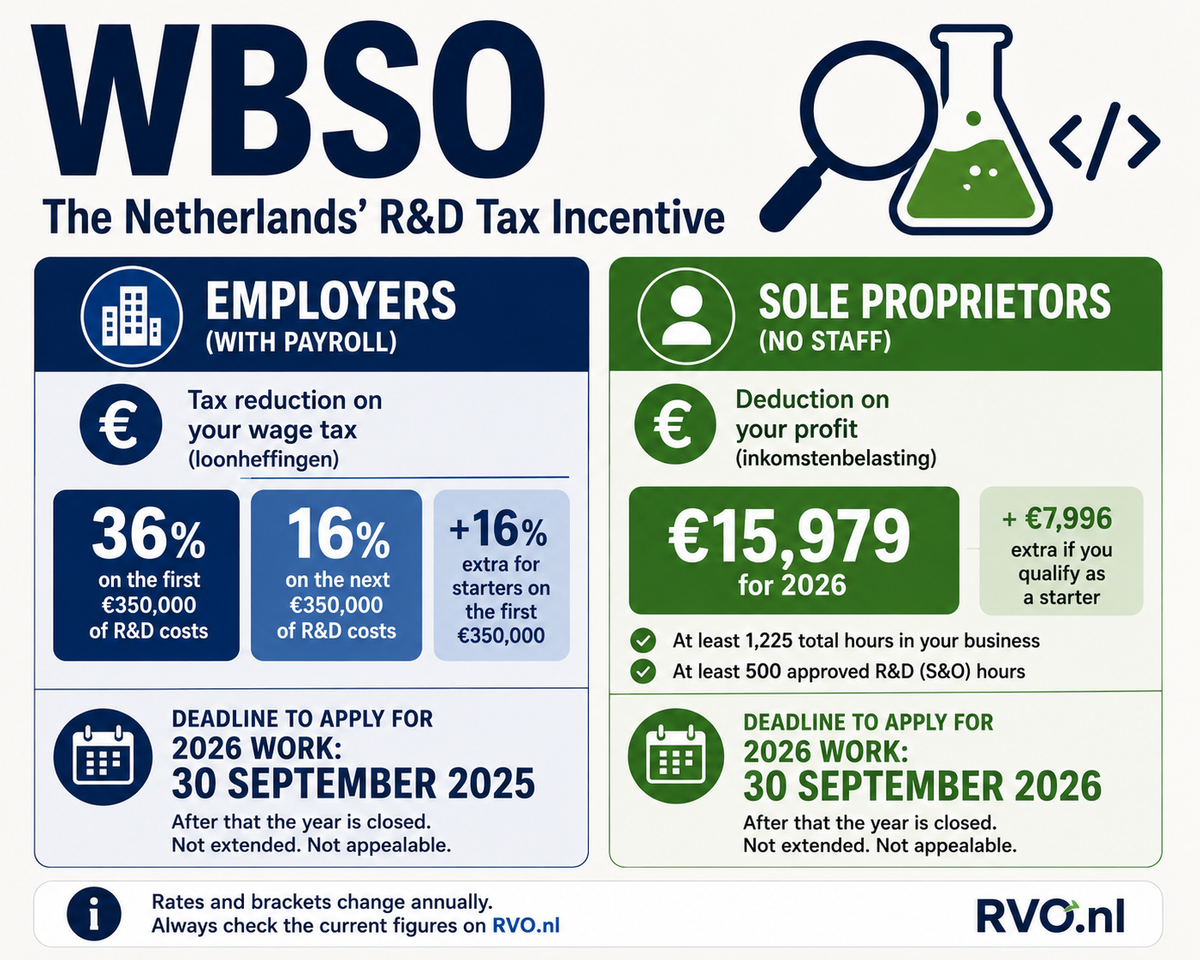
- Self-employed (the version most DAFT founders will use): a fixed deduction against your taxable profit. No wage costs, no payroll — just a flat amount you subtract from your income before tax.
- Payroll tax reduction: if you run a BV and pay yourself (or employees) a salary, you can instead reduce the wage tax you owe, as a percentage of R&D wage costs.
Most people who came over on DAFT are running a one-person eenmanszaak or ZZP-style business, at least at first, which means the self-employed version is the one that actually applies to you. That's the one this post focuses on.
Who's actually eligible
This is where people either underestimate themselves or overestimate themselves, and it's worth being precise about both directions.
The hour requirements: you need at least 500 hours in the calendar year spent on qualifying R&D work, out of a minimum of 1,225 total hours worked in your business that year. If you're already tracking hours for the standard self-employed hour criterion (the same 1,225-hour test that unlocks other Dutch tax benefits), you're already halfway to knowing whether this is realistic for you.
The "starter" bonus: if you haven't run your own business in at least one of the preceding five calendar years, you qualify as a starter — which almost certainly describes you if you moved here recently to start your DAFT business. That matters because the starter bonus roughly adds 50% more to the base deduction (more on the actual numbers below).
The part that actually disqualifies people: WBSO doesn't care whether your product is commercially innovative, disruptive, or a great idea. It only cares whether you had to solve a real technical unknown to build it — something that wasn't already a known, solved problem you could just implement. In practice:
- Building a website, webshop, or standard business app: generally doesn't qualify, even if it's well-built.
- Wiring together existing libraries, APIs, or no-code/low-code platforms: generally doesn't qualify — that's implementation, not research.
- Writing a custom algorithm because the off-the-shelf approach doesn't perform, scale, or work for your specific case: generally does qualify.
- Prototyping something that might not work, including the attempts that fail: generally does qualify.
The honest test is: did you have to figure something out that wasn't already known, or did you assemble known pieces well? Only the first one is R&D in the WBSO sense. This is also the single biggest reason applications get rejected or clawed back after the fact — people describe what they built (a nice product) instead of what was technically uncertain about building it (the actual thing being funded).
What it's actually worth
For 2026, the self-employed WBSO deduction is:
- €15,979 base deduction, plus
- €7,996 starter bonus if you qualify (see above)
- For a combined €23,975 taken off your taxable profit, if you're a qualifying starter
That's a deduction, not a check in the mail — the actual cash value depends on your marginal tax rate, but at typical rates for a small business owner it's a meaningful reduction in what you owe. It applies regardless of whether you worked exactly 500 hours on qualifying R&D or well over that — the self-employed amount is fixed once you clear the threshold, it doesn't scale up with more hours.
If you're running a BV with a payroll instead, the numbers work differently: 36% of the first €391,020 in R&D wage costs (50% if you qualify as a starting company), 16% above that. Worth knowing exists, but most solo DAFT founders won't be in this bucket yet.
How people actually file for this
There are three real paths, and which one makes sense depends mostly on how much you value your own time versus your own money.
1. Self-file, for free, directly with RVO. You write up your projects and the technical uncertainties involved, submit it to RVO (the Netherlands Enterprise Agency), and if approved you get an S&O-verklaring — the official approval. This costs nothing but your own time, and for a straightforward solo technical business it's genuinely doable. The catch, and it's a real one: the quality of your write-up is what gets you approved or rejected, and most people's first instinct is to describe their product rather than their technical risk — which is exactly the wrong emphasis. If you're going to self-file, it's worth spending real time getting the technical narrative right rather than treating it as a form to fill out. I wrote a longer piece on exactly what separates a fundable technical narrative from a rejected one, with a worked example, over on Kaperkunde if you want to go deeper before you write yours.
2. Hire a subsidy bureau, usually "no cure no pay." Most WBSO bureaus in the Netherlands work on a contingency basis — they only get paid if your application is approved, taken as a percentage of the subsidy value. As one data point, WBSOburo advertises rates starting around 5% no-cure-no-pay for straightforward cases; in practice, expect the percentage to run higher for smaller or more complex claims, since the bureau's time is roughly the same whether your claim is large or small. The advantage is they know the paperwork, the deadlines, and RVO's expectations cold, and there's no upfront cost. The real limitation, worth knowing going in: a bureau that isn't staffed by actual engineers can struggle with the exact same problem you'd have self-filing — telling the difference between a genuine technical risk and a nicely described product feature. You're still the one who has to be able to explain, in plain terms, what was actually uncertain about your work.
3. Ask your accountant first. If you already have a Dutch accountant handling your bookkeeping (most DAFT founders do), it costs nothing to ask whether WBSO makes sense for your business before going further. They may handle it themselves, point you to a bureau they trust, or tell you honestly that your work doesn't sound like a fit — which is useful information either way.
The deadlines, if you want to act on this now
WBSO runs on a quarterly application cycle, and the rule that trips people up is: you must apply before you do the work you're claiming for. You can't do the R&D first and then apply retroactively.
As of this writing, for the current 2026/2027 cycle: September 30, 2026 is the deadline to apply for the October–December 2026 quarter, and December 20, 2026 is the deadline for companies wanting a January 1, 2027 start date (self-employed applicants generally need to be in before January 1st itself for a full-year 2027 claim). These specific dates shift every cycle, so treat them as illustrative of the pattern rather than something to bookmark — check RVO's WBSO page for the current deadlines whenever you're actually ready to apply.
Once you're approved, the ongoing obligation is to keep daily hour records per project, updated within 10 working days — not reconstructed from memory at year-end — and to report your actual hours by March 31 of the following year. This is where a surprising number of otherwise-qualifying claims fall apart on audit, so if you go the self-file route, build the habit of logging hours as you go from day one.
Why this is worth a DAFT founder's specific attention
Beyond the tax savings, there's a quieter benefit for people on DAFT specifically: an approved S&O-verklaring is dated, government-issued documentation that your business is doing genuine technical work — not just paperwork you filed to satisfy a visa requirement, but a real credential a separate Dutch government agency independently reviewed and approved. I can't tell you exactly how IND weighs that kind of thing in any given case, and this isn't immigration advice — but as one more piece of evidence that your business is real and substantive, it's hard to see how it hurts.
This post is general information, not tax or legal advice — for anything specific to your situation, talk to a Dutch accountant, tax advisor, or immigration lawyer.